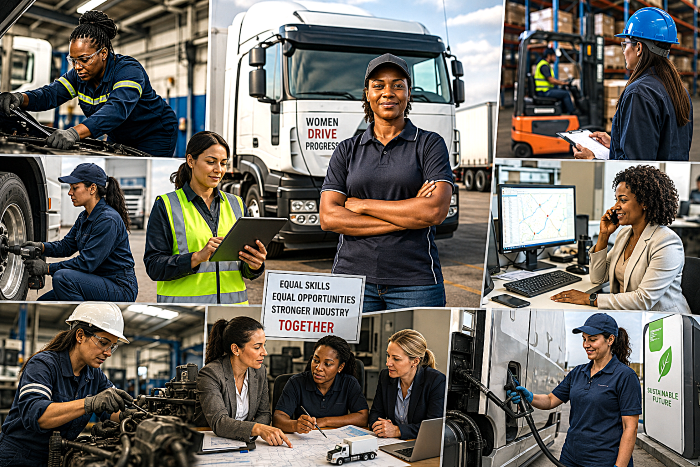
Women’s Month provides a timely opportunity for South Africa’s trucking and logistics industry to look beyond traditional talent pools. As the sector faces ongoing shortages of skilled drivers, technicians, artisans, engineers, managers and other operational specialists, women represent a significant and increasingly important source of talent. The opportunity is not simply about improving representation – it is about strengthening the industry’s ability to attract the skills it needs to remain productive, competitive and resilient.
The challenge is therefore not whether women can contribute to the future of trucking – they already are – but whether the industry can do enough to attract, develop and retain the female talent it needs.
In this opinion piece, Kereshma Naidoo, chief of staff and HR director: Africa at Babcock, explores this broader workforce challenge – one that applies directly to the road freight industry where access to talent increasingly determines winning performance. Over to Ms. Naidoo…
Challenges facing organisations are not technological. It is people
Across industry, conversations about competitiveness often focus on technology, infrastructure, investment and innovation. These are all important drivers of growth and performance. Yet one of the most significant challenges facing organisations today is not technological. It is people. The ability to attract, develop and retain the people who will drive future performance.
Across sectors such as transport, engineering, manufacturing, mining, energy and construction, organisations are navigating increasingly complex operating environments. New technologies are changing the way work is performed. Skills requirements are evolving. Experienced professionals are retiring. Competition for technical talent continues to intensify.
At the same time, businesses are under pressure to improve productivity, strengthen resilience and remain competitive in rapidly changing markets. The common denominator in all of these challenges is people.
While discussions about the future of work often focus on automation, artificial intelligence and digital transformation, the reality is that technology alone will not solve industry’s workforce challenges. People will.
Women represent an untapped talent pool
The organisations that succeed in the future are unlikely to be those with access to the most technology. They will be the organisations with access to the strongest talent pools, the most capable leaders and the cultures that enable people to perform at their best. This is why workforce capability is increasingly becoming a strategic business issue rather than simply a human resources priority.
For many organisations, the challenge is no longer finding jobs for people.
It is finding enough people with the right skills, experience and potential to meet future demand.
As workforce pressures continue to grow, organisations are being challenged to think differently about how they attract and develop talent. Increasingly, this means broadening access to opportunity and ensuring that talented individuals are able to contribute and progress regardless of traditional industry assumptions or historical barriers.
Women’s Month provides an important opportunity to reflect on this challenge.
Despite significant progress over many years, women remain underrepresented across a number of technical, operational and leadership roles in sectors such as engineering, mining, manufacturing, transport, energy and construction. Yet these are also the industries facing some of the greatest skills and capability shortages.
At a time when organisations are competing for increasingly scarce talent, the question is no longer whether industry should create opportunities for women. The question is whether it can afford not to. This is not simply a conversation about representation. It is a conversation about capability.
The conversation is also no longer about whether women belong in industry. That question has already been answered. Across transport, engineering, mining, manufacturing and energy, women are leading projects, operating equipment, managing operations, developing engineering solutions and shaping strategy at every level of business.
The focus today must be on ensuring that talented people have access to opportunities that allow them to grow, contribute and build meaningful careers. This is where the discussion around inclusion has evolved significantly.
From recruitment to retention
Leading organisations increasingly recognise that attracting talent is only part of the equation. Retaining talent, developing talent and creating pathways for growth are equally important.
People are more likely to build long-term careers where they feel valued, supported and connected to the organisation around them. In other words, where they feel they belong. Belonging has become one of the most important yet often overlooked elements of workforce strategy.
Creating a sense of belonging does not mean lowering standards or treating people differently. It means creating environments where individuals are respected, supported and given the opportunity to contribute meaningfully. It means ensuring that capability, performance and potential can be recognised wherever they exist. This is where mentorship plays a critical role.
Mentorship provides guidance, support and perspective, helping individuals navigate challenges, build confidence and develop the skills needed to progress. It creates opportunities to learn from experience, expand professional networks and gain the insight that often makes the difference between potential and progress.
Leadership development programmes, employee networks and professional communities further strengthen this journey by creating connections, increasing visibility and encouraging continuous growth.
At Babcock, initiatives such as Illuminate, our women’s development programme, are designed to fuel confidence, spotlight potential and support progression across our organisation. They recognise that creating meaningful opportunities requires more than recruitment alone. It requires a long-term commitment to developing capability, building confidence and unlocking potential. That commitment is becoming a defining characteristic of successful organisations.
Building the next generation of industry talent
The industries that will lead in the future will not necessarily be those with the largest budgets, the newest technology or the biggest facilities. They will be the organisations that recognise potential, invest in capability and create environments where talented people can succeed.
Women’s Month reminds us how far industry has progressed in broadening access to opportunity. It should also challenge us to consider how much more can be achieved when every talented individual has the opportunity to contribute, grow and lead.
Because the organisations that will be best equipped to solve tomorrow’s challenges are those drawing on the broadest possible range of skills, perspectives and experiences. That is not simply an inclusion objective. It is a business imperative.
Editor’s comment: If the trucking industry wants to broaden its talent pool, it needs to start earlier. Women’s Month is a useful reminder that attracting female talent cannot begin with a job advert – it needs to begin at school, college and university, where young women are still deciding what careers are open to them.
The industry needs to be visible in those spaces, showing that trucking is not just about driving trucks but encompasses technology, engineering, logistics, finance, fleet management, data, leadership and a host of other careers. Get them interested early, give them exposure and create clear pathways into the industry – because waiting until skilled talent enters the job market means competing for people everyone else is already chasing.
Click on photographs to enlarge