South Africa’s road freight industry faces a particular vehicle crime risk – hijacking – where criminals use force or the threat of force to take vehicles and products from drivers. The consequences can extend well beyond the loss of a truck and its cargo to include driver safety risks, operational downtime and lost revenue.
Tracker’s latest Vehicle Crime Index (VCI), covering January to June 2026, shows that business-owned vehicles, from cargo-carrying big rigs to LDVs, remain 17% more likely to be targeted (hijacking and theft) than privately owned (‘consumer’) vehicles.
Among reported crimes involving business vehicles, Tracker says truck hijacking incidents (vehicles en-route and loaded) are almost twice as numerous as truck theft incidents (unmanned vehicles), underlining the particular exposure of commercial transport drivers and their employers.
The risk is considerably greater in some provinces, states Tracker. In the Eastern Cape, business vehicle hijackings are almost five times more prevalent than business vehicle thefts, while in Mpumalanga they are more than eight times as prevalent.
Business vehicles face a different crime profile
Tracker defines business-owned vehicles broadly, ranging from cargo trucks with trailers to courier vehicles delivering online purchases. Although business-owned vehicles are still 17% more likely to be targeted than privately owned vehicles, this represents a significant improvement on the 48% differential recorded a year ago.
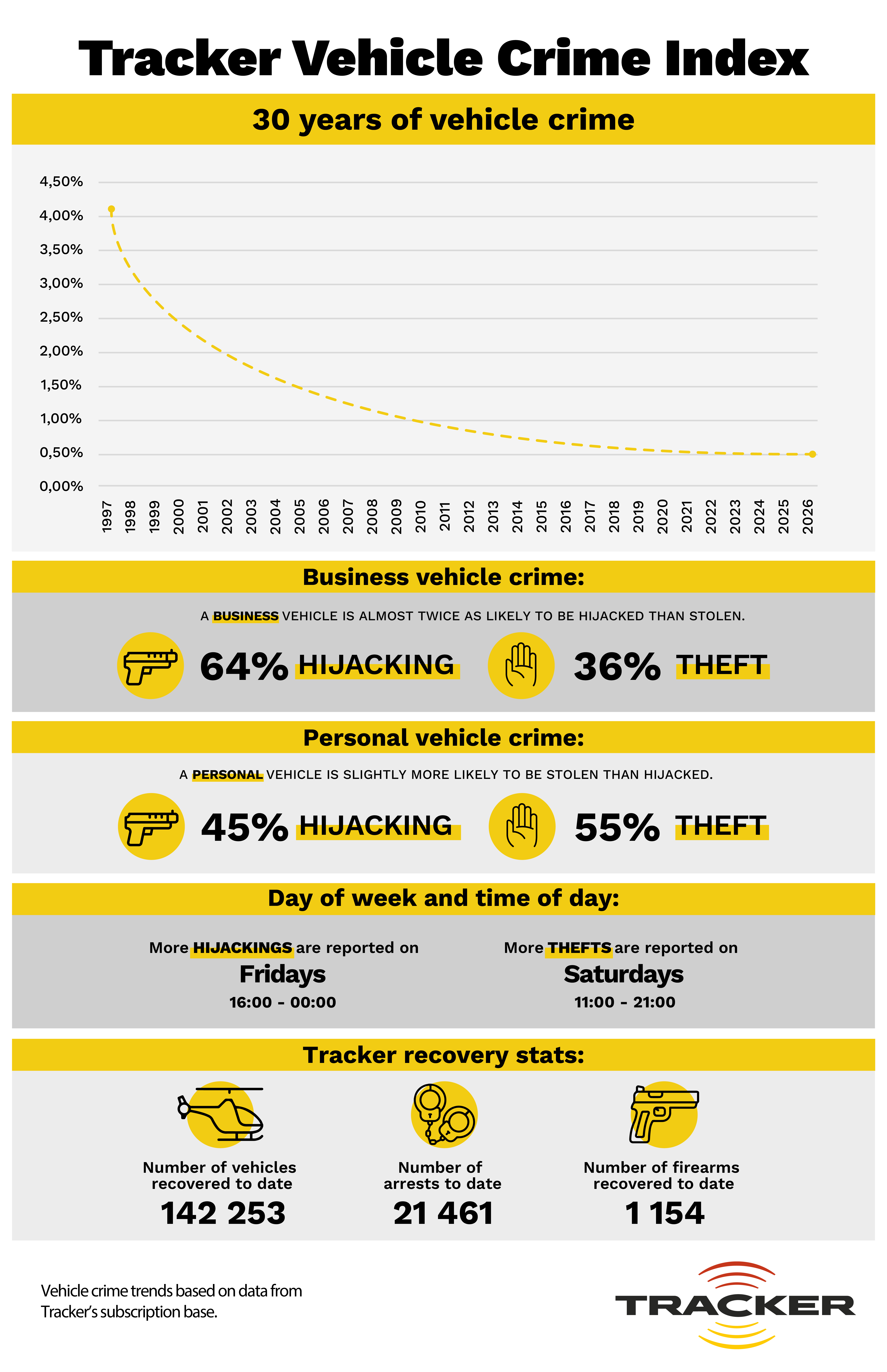
According to Tracker’s VCI, the national crime profile also differs between business and consumer vehicles. Business vehicles are almost twice as likely to be hijacked as opposed to stolen (64% vs. 36%), whereas consumer vehicle crime leans towards theft, which accounts for 55% of incidents compared with 45% for consumer vehicle hijackings.
Regional variations remain significant. While Gauteng and KwaZulu-Natal together account for 80% of all vehicle crime incidents, hijacking is more prevalent than theft in several other provinces. In the Eastern Cape, consumer hijackings are twice as prevalent as thefts, while in the Western Cape they exceed thefts by 42%. Mpumalanga also recorded more private-vehicle hijackings than thefts.
Nationally, theft and hijacking incidents are now evenly split – a notable shift from recent years when hijacking became the dominant crime type as vehicle usage and mobility returned to normal after the Covid-19 lockdown period.
When commercial vehicles are most vulnerable
The timing of vehicle crime also offers important insights for fleet operators. Nationally, more incidents are reported over weekends. Vehicle theft is most common on Saturdays between 11am and 9pm, with another concentration on Fridays between 4pm and 9pm. Hijackings peak between 4pm and midnight on Fridays.
Business hijackings, however, follow a slightly different pattern, occurring most frequently on weekdays between 4pm and 9pm.
For transport and logistics businesses, these patterns reinforce the importance of understanding operational exposure, including when vehicles are on the road, where they stop and how driver safety is managed.
“The data shows that vehicle crime continues to evolve, which means motorists and businesses need to evolve their response too,” says Duma Ngcobo, Chief Operating Officer at Tracker.
“Understanding where, when and how these crimes occur is one of the most effective ways to reduce risk. For businesses, the impact of vehicle crime extends far beyond the loss of a vehicle. Downtime, service disruptions and lost revenue often represent a far greater cost, making prevention, driver safety and rapid recovery critical to business continuity.”
Three decades of changing vehicle crime risk
The latest figures come as Tracker commemorates 30 years in South Africa’s vehicle tracking and recovery industry. A review of its historical data reveals that the proportion of Tracker customers affected by vehicle theft and hijacking has fallen from around 4% in the late 1990s to 0.5% in recent years. Several industry developments have contributed to this decline.
The introduction of free vehicle tracker fitment in the late 1990s removed the upfront cost barrier for motorists. In the early 2000s, expanding stolen vehicle recovery networks encouraged insurers to offer premium discounts for vehicles fitted with tracking systems.
The emergence of connected vehicles and telematics data in the mid to late 2000s subsequently opened the door to more sophisticated applications. By the early 2010s, this information was being used to develop driver-behaviour insights, usage-based insurance models and safety incentive programmes. More recently, connectivity and data have been leveraged at scale to support fleet management and a broader range of telematics services.
“As a pioneer in the South African vehicle tracking and recovery market, established in response to South Africa’s soaring post-apartheid vehicle crime crisis, Tracker has played an active role in the industry’s evolution, helping develop the technologies, partnerships and insights that have reduced vehicle crime risk over the past 30 years,” says Ngcobo.
“Over that time, our role has also expanded beyond recovering stolen vehicles. While vehicle recovery remains at the heart of what we do, we’ve become a trusted source of data-driven insights that help motorists, businesses, insurers and fleet operators better understand risk, improve safety and make more informed decisions.”
Recovery remains central to fleet protection
Tracker says it remains committed to using technology, data and innovation to protect people, vehicles and businesses across South Africa.
To date, the company has recovered 142 253 vehicles, assisted in 21 461 arrests and helped recover 1 154 firearms. It also reports an industry recovery rate of 96% for the last financial year.
Editor’s Comment: The reduction in vehicle crime over three decades is encouraging, but the latest figures highlight a critical distinction for the road freight industry: commercial vehicles face a different risk profile from private motorists. For fleet operators, a hijacked truck can mean the loss of the vehicle, its cargo, delivery commitments and valuable operating time. And then there’s always the possibility of loss of life.
While tracking and recovery technology are important parts of the response, the wider challenge always is to prevent hijacking from happening – to integrate crime intelligence, route and driver safety management into everyday fleet operations – because the reality is harsh: the cost of a hijacking is seldom confined to the vehicle itself.
Click on images to enlarge