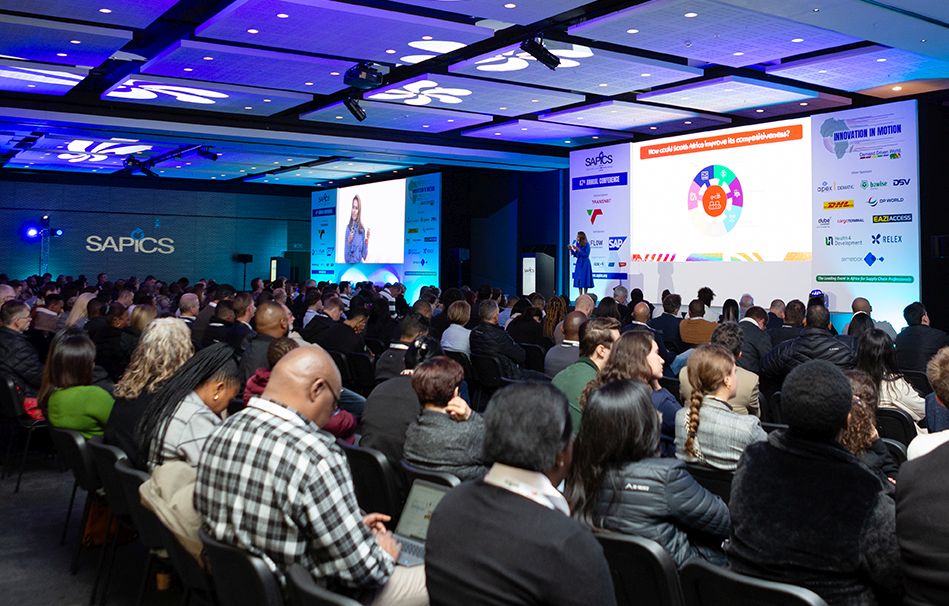
As Africa’s logistics, freight and manufacturing corridors continue to realign around intra-continental trade and increasingly complex offshore supply chains, 2026 is shaping up as a decisive year for leadership in supply chain management. Against this backdrop, SAPICS has issued its formal Call for Speakers for the 48th Annual SAPICS Conference, taking place from 19–22 July 2026, marking 60 years of influence in South African and African supply chain management.
SAPICS President Thato Moloi describes the moment as one of both reflection and responsibility: “As SAPICS celebrates its 60th anniversary, we stand at a remarkable crossroads where we reflect on a legacy built through connection, collaboration, and transformation, while looking ahead to a future led by bold, values-driven leadership.”
For fleet operators, logistics service providers and transport-linked industries, the timing is significant. Cross-border integration under the AfCFTA (African Continental Free Trade Area), infrastructure investment cycles and global trade volatility are forcing supply chains to balance resilience, cost, sustainability and human capability at scale, challenges that will ramp up in 2026.
SAPICS 2026 aims to address these realities head-on and insights from the trucking sector will add a vital element to the forum.
Legacy to leadership – practical themes for a volatile world
The conference theme, ‘Legacy to Leadership: 60 Years of Connection, Collaboration & Transformation’, is positioned by SAPICS as more than a milestone: “Our 48th Annual Conference is not only a celebration of where SAPICS has come from, but an invitation to shape where it is going,” Moloi says.
That invitation is grounded in a sharply defined programme of topics reflecting the pressures reshaping global and African supply chains. SAPICS is calling for presentations addressing artificial intelligence as an essential operational capability, digital integration and connectivity, big data and advanced analytics, and the impact of trade policy, geopolitics and global trade dynamics.
Operational execution is equally central, with focus areas including automation at scale across warehouses and logistics networks, supply chain risk management, agility and resilience in managing volatility, uncertainty, complexity and ambiguity, and the evolution of the workforce to close critical skills gaps.
Visibility, traceability and performance metrics, cybersecurity, supply chain optimisation beyond cost cutting, and more dynamic, customer-centric approaches to strategic sourcing and supplier management are also high on the agenda.
SAPICS notes that “the 48th Annual SAPICS Conference will explore how supply chains can lead responsibly – balancing purpose and performance, technology and humanity, efficiency and equity.”
A clear opportunity for road freight voices
Importantly for road freight professionals, SAPICS is actively encouraging practitioner-led submissions. All speakers are selected on merit and relevance, with case studies and applied presentations especially valued.
The conference committee is seeking fresh perspectives to ensure innovative and diverse content for attendees.
This represents a strategic opportunity for road freight industry leaders to step forward and ensure the realities of trucking, fleet operations, corridor performance, cross-border compliance and infrastructure constraints are fully represented in broader supply chain discourse.
As road freight remains the backbone of intra-Africa trade and a critical link in offshore supply chains, its voice is essential in shaping future-ready supply chain leadership.
SAPICS emphasises that leadership must extend beyond organisational boundaries. “From seasoned leaders to emerging voices, SAPICS 2026 will celebrate the people and ideas that continue to move supply chains forward,” the organisation says. “It will challenge us to look beyond silos, collaborate across industries and borders, and re-imagine what leadership means in a world that never stops evolving.”
Moloi reinforces the importance of continuity and shared ownership: “For six decades, SAPICS has been the home of supply chain professionals and practitioners in South Africa and across the continent – a community that learns together, grows together, and leads together.”
Editor’s Comment: For truck fleets operating at the sharp end of supply chain execution, SAPICS 2026 presents a platform where strategic narratives are formed, priorities are set and future investment logic is shaped. If road freight does not actively contribute to that conversation, its interests risk being interpreted rather than articulated.
The Call for Speakers is therefore a timely prompt for fleet operators, logistics executives and transport technologists to put forward credible, practitioner-led insights. In a year where Africa’s supply chains will be tested on resilience, integration and leadership, the road freight sector has both the experience and the responsibility to help define the future of effective Southern African supply chain leadership.
Visit the SAPICS ‘Call for Speakers’ webpage.
Click on photographs to enlarge