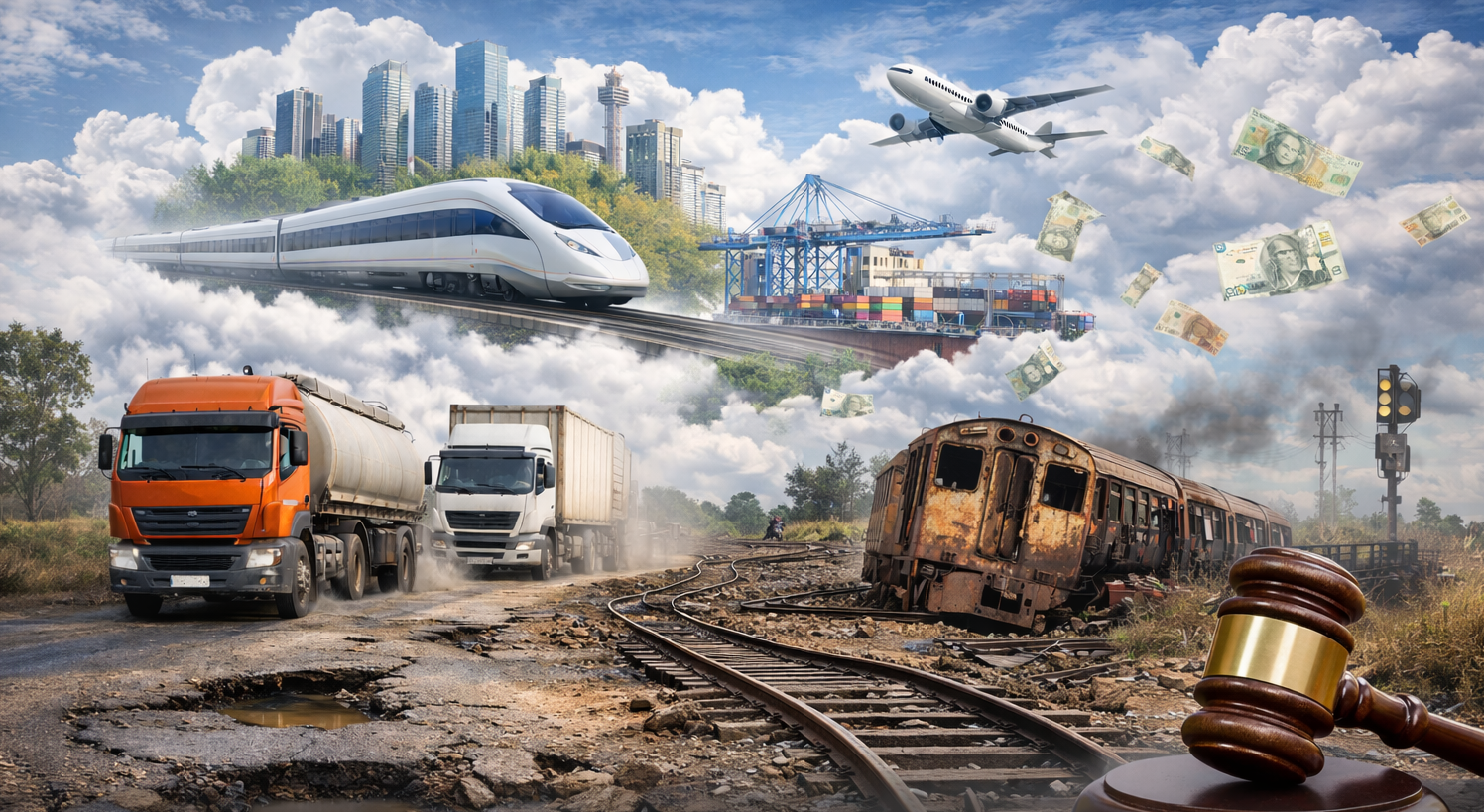
South Africa’s 2026 Budget has been cautiously welcomed by business but within the road freight sector, the reaction is more measured than celebratory. While tax threshold adjustments and SMME relief offer breathing room, increases in the general fuel levy and unresolved structural questions around rail reform temper optimism.
In this opinion piece, Gavin Kelly, CEO of the Road Freight Association (RFA), examines what the Budget really means for transport operators, small fleet owners and the broader logistics value chain – and why implementation, not intention, will determine whether the sector strengthens or stumbles. Over to you Mr Kelly….
Budget 2026 – Road Freight, Reform and the Reality Check
South Africa’s 2026 Budget lands at a pivotal moment for the road freight sector. There are encouraging signals in the numbers – but also familiar structural concerns. As an industry that quite literally carries the economy, we look beyond headline relief to ask a harder question: will this Budget strengthen logistics competitiveness, or merely postpone deeper reform?
From windfall to warning – tax relief built on commodities
The Road Freight Association notes that the planned additional R20-billion to be taken from individual taxpayers has been dropped – thank goodness for that. This is largely due to the commodities boom that has saved our necks. (Editor’s Note: With the bulk of export commodities hauled to ports by road in the absence of an efficient rail network. Thanks truckers). The question is: what does that mean for 2027 should the commodities boom have long disappeared?
Another question remains as to whether that “boon” will still disappear into the deep, dark pit of government spending.
Both personal income tax brackets and capital gains tax thresholds have been raised in line with inflation – a very good sign and another relief for the average citizen.
More importantly, asset disposals for small businesses will be exempted up to a maximum of R15-million. SMMEs make up 80% of our Association’s membership – this exemption is vital for their sustainability and growth.
Similarly, VAT and turnover tax thresholds will be raised for micro businesses to account for inflationary pressures – a huge “win” for another portion of our membership. This means those businesses have a fighting chance to grow – something we have debated and discussed with various government departments for at least a decade.
It is important to understand that cash injections – initial funding – do not guarantee business stability and growth. The real key to sustainability lies in building bulkheads – strong protections to ensure that assets appreciate and the business develops securely.
This latest step puts us on the right path. It allows cash-starved but capital-rich businesses to grow with some protection before they become exposed to fuller and further-reaching taxation.
The “general” fuel levy – who really benefits?
The largest levy faced by the road freight sector has to be the “general fuel levy”. Yet there are a plethora of so-called “stealth taxes” in vehicle sales, including carbon taxes, visible tolls, licence fees, permits and special tariffs for specific operations, municipal compliance and registration tariffs for dangerous goods – both transported and warehoused – as well as parking and special use areas within local authorities.
The problem is the word “general”. The levy goes more to other aspects of government expenditure than to the infrastructure used by the purchasers of fuel. Is that not what it is meant to be – a user levy?
In the main, allocated funding from the general fuel levy has reportedly not been used for road infrastructure but for other urgent priority issues such as education, water, electricity and health. These are not incorrect priorities in themselves – but the deterioration of road networks not under the domain of South African National Roads Agency Limited has been noticeable.
The wording is important: “general fuel levy” as opposed to “road fund levy”. Perhaps that is where it has all gone wrong.
Thus, here we go again with an increase in the general fuel levy. It is being raised by R0.21 per litre for diesel. The impact may not be felt immediately as the international price of crude oil has continued to drop. However, we now import finished product due to our refineries having gone offline – so that relief may be temporary.
One of the reasons given for the increase is the Road Accident Fund. The RAF has an incredible capacity to absorb vast quantities of taxpayers’ money without really offering much in return.
Rail reform or rail rhetoric? Structural conflicts remain
In his Budget Speech of 25 February 2026, the Minister of Finance noted: “In logistics, we are dismantling bottlenecks in rail and ports that have throttled exports and raised the cost of doing business. Our intention is to bolster public-private investment in rail operations while retaining state ownership of rail infrastructure. The objective is to move goods faster, cheaper and more reliably.”
There are a number of hurdles with this approach – not least whether moving freight by rail will in fact be less expensive than by road. In most cases, there will still be road freight legs before and after rail links.
In addition, with Transnet still owning the infrastructure – an arm’s-length state-owned enterprise with a new name – and still operating trainsets on the same rail routes, how will the private sector be guaranteed a fair chance when it becomes obvious they are outperforming Transnet? If we quote the phrase “Operation Vulindlela” often enough, will that ensure efficient implementation and operation?
Just like the unbundling of Eskom, the time has come – as the Association has said for the past two decades – for Transnet to be privatised, or for route concessions similar to toll roads, if real change is to occur. Transnet cannot be the referee and a competitor at the same time.
There have recently been media opinions about the actual profitability and real cost savings of rail transport. The clincher is consistent volumes across a reliable and dependable rail system – continuous volumes, reliable scheduling, sustainable train capacities and secure cargo across the entire rail offering.
Public-Private Partnerships – priority or distraction?
It is clear from the budget proposals that government is placing increasing responsibility for traditionally tax-funded infrastructure projects at the doorstep of private business, through Public-Private Partnerships.
Some of these projects – such as high-speed passenger rail links between Gauteng and Limpopo, KwaZulu-Natal and even within the Gauteng “mega-metropolis” concept – are not what the country needs right now. Are these vanity projects, or opportunities for further troughs for feeding loyal cadres?
The criminal prosecution system is teetering on the point of collapse. Service levels at local police stations, prosecution rates through the courts – cases need to reach the courts first – and the rampant operations of various mafias within specific sectors and industries all point to deeper structural priorities.
With the sugar industry reportedly on the verge of collapse and media suggesting more than 50 000 jobs at risk, should this not rank higher than building a high-speed rail link? The logistics network needs direct investment – and the role of private players needs to be understood, welcomed and protected from state ravaging and misuse. Is that possible?
Partnerships should be leveraged to ensure compliance, fairness and sustainability. The road freight sector is already ravaged by operators who choose not to follow the prescripts of the Labour Relations Act, the National Road Traffic Act and other key legislation that should create a level playing field. The symptoms are poorly maintained vehicles, undocumented foreign drivers, dangerous driving habits and corruption in many forms.
PPPs must focus on ensuring fair access to well-maintained infrastructure, adherence to the rules and equitable contribution to the development of both the state and business.
Reform, not rhetoric – a logistics reality check
The Association notes that the general financial standing of the country is improving – and that should not be dismissed. However, it is time for government to acknowledge that it is not in the business of logistics in this context. That role should be left to private sector experts who have proven capability. The state’s role is to ensure compliance with the rules, allowing all participants to operate fairly and freely within the sector.
Now is the time to rehabilitate dilapidated roads through the fuel levy – not merely to refer broadly to infrastructure projects at local and regional levels, or to note that SANRAL maintains a defined set of roads. SANRAL cannot be responsible for all roads.
Alongside this, key rail links should be concessioned – similar to toll routes – and the ends of those routes, whether ports or land borders, must be able to move volumes efficiently and effectively, with scope for growth. We are already losing volumes through Beitbridge and the Port of Durban to other ports in the African sub-continent due to the poor operation of our assets.
The time for incremental adjustment has passed. What is required now is structural reform, implemented with intent.
Editor’s comment: Kelly’s assessment reflects a familiar tension in South Africa’s logistics debate. Treasury is signalling fiscal consolidation and reform, yet structural contradictions remain embedded in freight rail, fuel levy allocation and infrastructure prioritisation. For local trucking, the message is clear: marginal tax relief is welcome, but operating costs, compliance distortions and infrastructure reliability remain the real battleground. If the state is serious about logistics-led growth, execution will matter more than rhetoric – and the private sector will expect measurable change, not incremental adjustment.
Click on photographs to enlarge