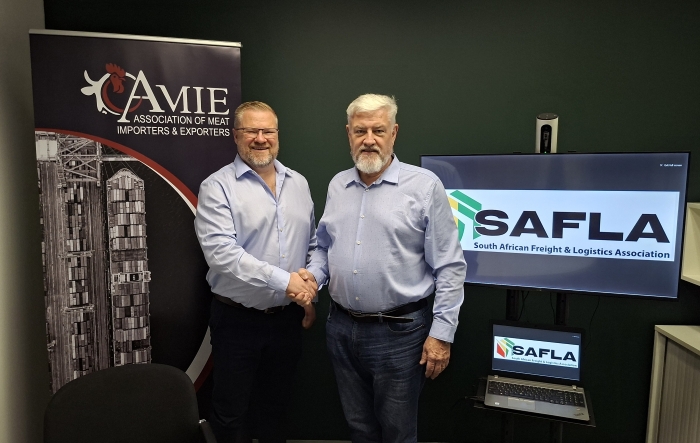
South Africa’s agricultural exports include temperature-sensitive commodities such as meat, making delays at ports, border posts or inspection points rapid eroders of international competitiveness and disrupters of domestic supply chains. Consequently, the South African Freight and Logistics Association (SAFLA) and the Association of Meat Importers and Exporters of South Africa (AMIE SA) have signed a Memorandum of Cooperation (MoC) aimed at improving collaboration on the logistics, regulatory and operational issues affecting the country’s meat trade.
The agreement provides a framework for both organisations to identify recurring constraints, share industry evidence and develop practical proposals for engagement with government departments and other stakeholders.
Areas of focus include port operations, border processes, veterinary and sanitary requirements, market access, rail and road connectivity and broader supply chain resilience.
Speaking with one industry voice
“Logistics is fundamental to food security, trade competitiveness and economic growth,” says Jonathan McDonald, vice chairman of SAFLA.
“This MoC gives SAFLA and AMIE SA a stronger platform to speak with one informed voice, engage constructively with government agencies and work with them to resolve issues that affect cargo flow, costs and reliability. We are most effective when industry brings evidence, expertise and practical solutions to the table.”
Paul Matthew, CEO of AMIE SA, says closer collaboration between industry and government will be essential if South Africa is to capitalise on export opportunities.
“We have the product, the capability and markets that are ready to buy South African meat,” says Matthew. “What is required is effective coordination: clear communication between national and provincial authorities, efficient certification and inspection processes, and a willingness to bring the private sector into the solution.”
For exporters, maintaining consistent supply into international markets remains critical. Delays in market access approvals or veterinary certification can result in overseas buyers sourcing product elsewhere.
Animal health events also remain a significant trade risk, reinforcing the need for robust traceability systems, credible disease controls and internationally recognised regionalisation measures.
Matthew notes that export growth should not be viewed as competing with domestic affordability: “Export markets enable producers to obtain value for different cuts across the carcass. That improves overall carcass balance and can support a more sustainable, affordable domestic supply.”
Improving logistics performance
The MoC also recognises that food safety and regulatory compliance remain essential, while calling for administrative processes that are rigorous, proportionate and consistently applied without creating unnecessary delays that affect trade, employment or consumer access to protein.
According to AMIE SA, South Africa exported approximately 81 000 tonnes of red meat – including beef, sheep and goat meat – worth around R6.3-billion between 2025 and May 2026, highlighting the sector’s export potential despite disease-related and administrative challenges.
The freight forwarding industry supporting this trade is equally significant. South Africa’s freight forwarding market is estimated to have generated around R81-billion in revenue during 2025, with freight forwarders coordinating more than 80% of the country’s international trade.
“Meat trade depends on logistics, predictable inspection and cargo release processes, veterinary controls and reliable access to international markets,” says McDonald.
“When these systems do not operate in concert, the consequences are felt by producers, importers, exporters, cold stores, transporters, processors, retailers and consumers.”
While industry has welcomed recent improvements to infrastructure and equipment at the Port of Durban, operational challenges remain around cold chain capacity, container handling, inspection coordination and the timely release of consignments.
“Through industry engagement, communication and joint advocacy, SAFLA and AMIE SA intend to help convert recurring challenges into coordinated action,” concludes McDonald:
“The associations believe that a unified industry voice, combined with respectful partnership with government, can improve the country’s logistics ecosystem, strengthen national supply chain performance and support a competitive, resilient South African meat sector.”
Editor’s comment: The SAFLA and AMIE SA agreement reflects a growing recognition that logistics has become a strategic enabler of agricultural trade rather than simply a transport function. As South Africa seeks to expand export markets, improved coordination between freight operators, regulators and exporters will be essential if the country is to build more resilient, efficient and globally competitive supply chains. May the ‘wors’ be with you!
Click on photograph to enlarge