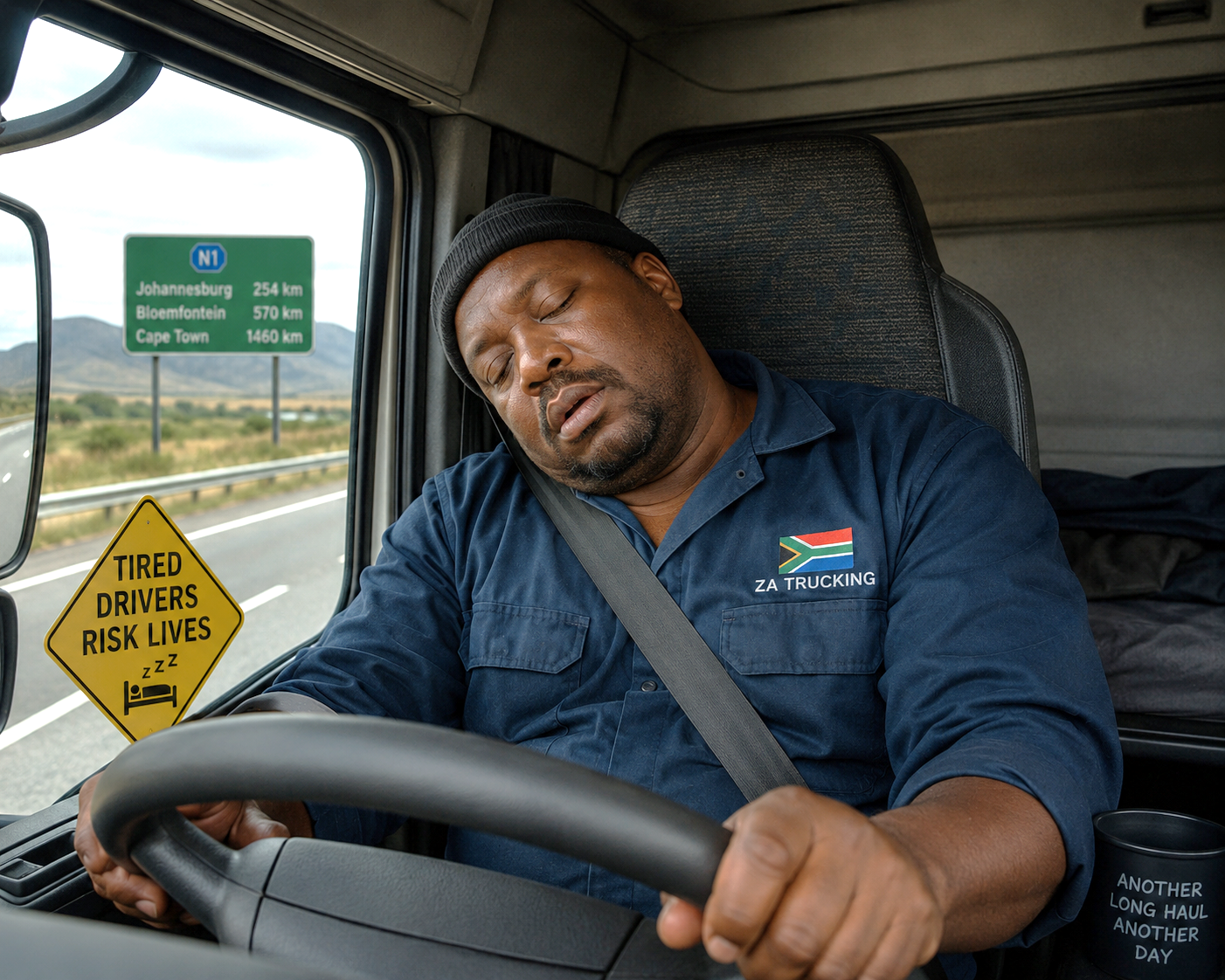
Driver fatigue remains one of the most uncomfortable truths in South Africa’s road freight environment. In a sector built on tight schedules, long-haul corridors and relentless delivery pressure, the greatest risk is often not mechanical failure or criminality but human exhaustion. Optix Group Executive for Product and Culture Inge-Marie Hilligan argues that fatigue is the hidden threat quietly undermining road safety performance.
“The unfortunate truth is that human error is still to blame for a high proportion of fatal crashes and fatigue is one of the most serious and underestimated contributors. This is particularly acute in South Africa, where truck drivers can legally work up to 90 hours a week.
“The country reports one of the world’s highest road-traffic fatality rates at approximately 24 to 25 deaths per 100 000 people – four to five times higher than the European Union average,” she says.
A crisis that starts with a phone call
“Every fleet manager dreads the call that tells them of an accident,” says Hilligan. “They know that in seconds, a routine journey can become a crisis, resulting in injured drivers, damaged vehicles, halted operations and in the most tragic scenarios, a driver who never arrives safely home.”
In South Africa’s context, that risk is amplified by extended legal driving hours and high baseline crash statistics. Beyond the human toll, the commercial implications are profound. Medical costs, repairs, higher insurance premiums, operational disruption and workforce shortages all compound the damage.
The broader economic burden is equally stark, with annual crash costs estimated at around R200 billion – close to 3% of GDP. Fatigue, in other words, is not just a safety issue. It is a boardroom issue.
The invisible warning sign
Unlike speeding or harsh braking, fatigue leaves no obvious digital footprint. “Fatigue doesn’t offer any obvious warning signal. Even a brief lapse can have catastrophic consequences,” Hilligan notes.
She offers a sobering illustration: “A five-second microsleep at 100km/h means a vehicle can travel more than 130 metres completely uncontrolled – roughly the length of a rugby field.”
Historically, this has made fatigue notoriously difficult to police or even quantify. However, Hilligan believes technology is shifting that balance.
AI in the cab – and humans behind the screens
“Early detection is the first line of defence,” she says. Advances in AI-powered video telematics are now capable of identifying multiple fatigue indicators, including subtle eye and head movements.
Crucially, she explains, “it can distinguish between a driver momentarily looking down to change gear and one whose head is dipping from drowsiness.”
Real-time alerts – via seat vibration or audio-visual prompts – give drivers the opportunity to act before a lapse becomes a tragedy. “The improved accuracy and lower level of false positives means that drivers take these alerts seriously,” Hilligan adds. Yet technology alone is not enough. “If a driver falls into a microsleep, rapid human intervention is crucial.”
Hilligan describes how early-warning control tower services add a second layer of defence. Specialist agents review AI-flagged mini-clips and escalate high-risk cases within minutes.
“At Optix, our team of highly trained people reviews up to two million video events a month. In 2025 alone, this helped to prevent tens of thousands of incidents globally.”
For fleets, this represents a fusion of artificial intelligence and human judgement – an increasingly necessary combination in high-risk environments.
From reaction to prediction
The most advanced operators, Hilligan argues, are now moving beyond incident response towards predictive risk management: “Prevention does not end here. The most sophisticated fleets are using technology to understand why fatigue is occurring.”
By analysing verified data, fleets can pinpoint problematic shift structures, specific corridors or high-risk time windows.
“Our own data highlights, for example, that fatigue on South African roads is worst in the early morning. Between 4am and 6am, drivers on certain highways in Mpumalanga face the highest risk, followed by stretches of road in Gauteng province and Limpopo,” Hilligan adds.
Armed with these insights, fleets can review scheduling, adjust break structures and strengthen coaching interventions. “Managing fatigue effectively goes way beyond installing hardware in a vehicle. It requires a coordinated approach: technology to detect risk, human expertise to act decisively and data analytics to anticipate and prevent escalation,” Hilligan concludes.
Editor’s comment: Driver fatigue management has moved beyond simply being a compliance exercise or a driver wellness and safety intervention. It is now an explicit strategic fleet and road safety pillar. And in a country where every uncontrolled metre can have life-altering consequences, proactive intervention may be the most important investment a fleet can make. The integration of AI detection, real-time human oversight and predictive analytics signals a maturing approach to driver safety. The fleets that treat fatigue as a measurable, manageable operational variable – rather than an unfortunate inevitability – will not only protect lives but strengthen resilience in an increasingly unforgiving operating environment.
* Main image A1 generated.
Click on photographs to enlarge.