South Africa’s waste management industry is approaching a critical turning point as shrinking landfill capacity, low recycling rates and mounting municipal pressures highlight the need for more efficient, sustainable ways to collect, process and recover waste. The scale of the challenge is substantial says leading waste management equipment company 600SA.
According to Sonia Pretorius, National Sales Manager for 600SA, a division of CFAO Equipment, the industry needs to move beyond conventional waste collection and disposal towards solutions that support resource recovery and a more circular economy.
“Industry figures cited at recent waste management forums note that only about 11% of waste is currently recycled, while approximately 89% ends up in landfill. Organic waste diversion is even lower, at an estimated 5%.
“With municipalities under increasing pressure to reduce the volume of waste sent to landfill rather than simply expand existing sites, the transition towards more sustainable waste management practices is no longer optional,” she says.
The circular economy, waste separation at source and improved recycling infrastructure are becoming increasingly important to the industry’s future.
However, Pretorius notes that meaningful progress requires more than policy changes. It demands practical solutions, smarter infrastructure and collaboration across the entire waste value chain.
Waste collection equipment has a bigger role to play
For 600SA, this changing landscape has prompted a closer look at how waste collection equipment can contribute to the bigger picture. While refuse compactors remain essential to municipal and commercial waste collection, the future calls for equipment that supports resource recovery alongside efficient waste disposal.
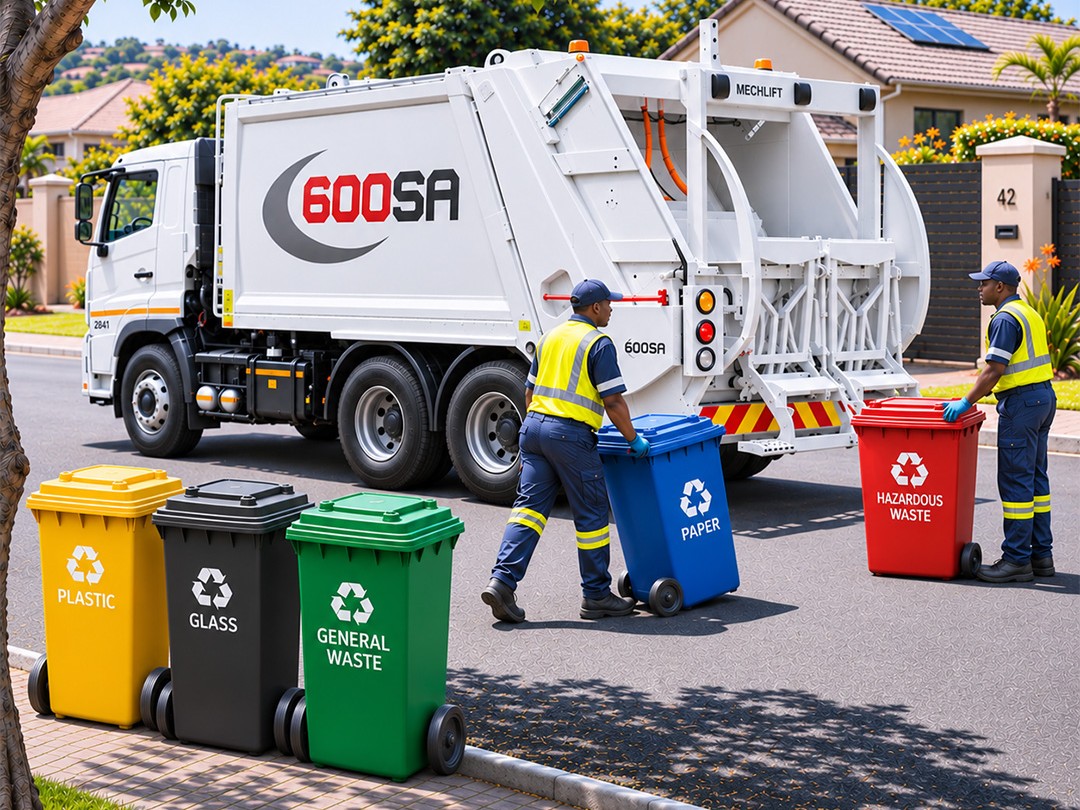
One practical development is the introduction of split-bin compactors. Featuring separate compartments within a single unit, these machines allow selected waste streams to remain segregated during collection, reducing the risk of recyclable materials becoming contaminated by general waste.
Depending on local collection and processing requirements, compartments can accommodate recyclables, organic waste or garden waste.
The approach could also help municipalities and contractors streamline collection operations, potentially reducing the need for separate collection vehicles and unnecessary trips.
When supported by conveniently located sorting and recycling facilities, split-bin compactors offer an opportunity to improve efficiencies throughout the waste management chain.
Data and technology can improve collection efficiency
Technology is another important part of the equation. Through the integration of Radio Frequency Identification (RFID) and onboard weighing systems, waste collection vehicles can capture valuable operational data, including collection volumes, bin lifts and waste distribution.
“Combined with telematics, this information can help municipalities better understand their waste generation patterns, optimise collection routes, assess fleet requirements and make more informed infrastructure decisions,” Pretorius explains.
Such capabilities can provide municipalities and waste contractors with greater visibility of collection operations, helping them make better use of available resources while identifying opportunities to improve service delivery.
Building a more circular waste economy
Ultimately, South Africa needs to move beyond simply collecting and disposing of waste. Recovering valuable resources, supporting small and medium-sized recycling enterprises (SMEs), improving conditions for waste pickers and strengthening the circular economy must all form part of the solution.
Pretorius says that at 600SA, the focus is on evolving alongside the industry by offering practical solutions today while actively exploring what tomorrow’s waste management landscape will demand.
“The challenge is substantial, but so is the opportunity. South Africa cannot afford to keep burying resources that could be recovered, reused and given new value. The need to rethink waste management has never been more urgent,” concludes Pretorius.
Editor’s comment: South Africa’s waste challenge is also a resource recovery opportunity. But realising that opportunity requires more than recycling targets and municipal policy commitments. It calls for investment in collection infrastructure, sorting facilities, technology and the operational capacity to keep valuable materials in circulation.
Equipment such as split-bin compactors and data-enabled collection vehicles could help bridge the gap between waste collection and resource recovery. The bigger challenge, however, is ensuring that the infrastructure and collaboration needed to make the circular economy work are developed alongside the equipment.
Click on photograph to enlarge