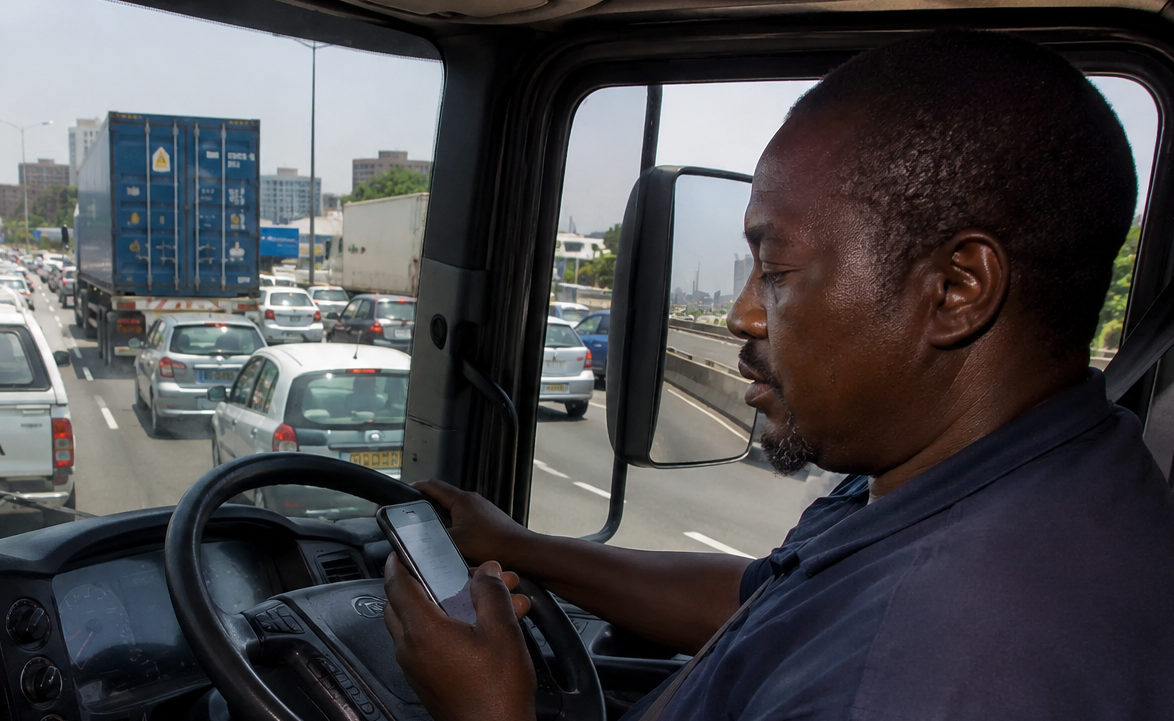
For professional truck drivers, distraction is not simply a personal road-safety issue – it is a fleet risk with potentially serious consequences for people, vehicles, cargo and businesses. A momentary lapse in concentration behind the wheel of a heavy commercial vehicle can have far-reaching consequences, making the growing number of distractions in today’s connected vehicles an issue that fleet operators and drivers cannot afford to ignore.
Sherry Sibeko, executive head of personal lines at MiWay Insurance, warns that even a few seconds of inattention can have significant consequences: “We see time and time again how taking your eyes off the road can quickly lead to an accident, placing both you and other road users at risk.”
The World Health Organization warned as far back as 2011 that distracted driving was a “serious and growing threat to road safety”, noting that rising mobile phone ownership was likely to escalate the problem.
Today, with mobile phone ownership in South Africa almost ubiquitous among working adults, it is only part of a progressively more complex distraction problem.
From real-time navigation apps and hands-free calls to voice-activated AI assistants, streaming services and connected infotainment systems, modern vehicles offer unprecedented convenience. Yet each notification, voice prompt or moment of divided attention can pull focus away from the road, says Sibeko.
Distraction takes more than one form
These distractions, Sibeko notes, are by no means limited to mobile phones. Driving distractions generally fall into three categories: visual, manual and cognitive.
“But the greatest risk occurs when these distractions overlap. Looking away from the road, taking your hands off the steering wheel and shifting your mental focus away from driving, even briefly, can significantly increase the likelihood of an accident,” she adds.
For truck drivers, the challenge is particularly significant. Long hours behind the wheel, busy operating environments and the demands of managing a large commercial vehicle already require sustained concentration. Adding technology, communication and other competing demands to the driving task can further compromise that focus.
Cellphones remain a major risk
Cellphone use, however, remains one of the most common driving distractions. As Sibeko points out, the South African National Road Traffic Act prohibits the use of hand-held communication devices – including cellphones – while driving.
“It is illegal to drive a vehicle while holding a phone in your hand or with any other part of your body, regardless of whether the vehicle is moving or not,” she says.
If caught, one could face a R500-R1 000 spot fine, depending on the metro. In metros with a confiscation law, a phone may be confiscated for 24 hours, with a release fee of up to R5 000 to get it back.
While each insurance claim is assessed on its own merits and according to the terms of the relevant policy, the financial consequences of a distracted-driving incident can extend well beyond a fine or insurance claim – an eventuality commercial truck fleet operators can ill afford.
Planning can remove distractions
Fortunately, reducing distractions often comes down to a few simple habits, Sibeko advises. Before hitting the road, drivers should pre-programme navigation systems, select their playlists and ensure that any necessary calls are made.
She adds that mobile devices should be placed out of reach or connected through approved hands-free systems where appropriate. Drivers should also avoid eating, grooming or attempting to multitask while behind the wheel.
“It helps to create an environment where your primary focus remains on the road,” says Sibeko. “We all lead busy lives where multi-tasking has become the norm, but many distractions are entirely preventable with a little planning before you set off.”
She also recommends taking regular breaks on long road journeys, particularly when fatigue begins to affect concentration, as this can also lead to accidents.
Technology must support – not compromise – safety
For the trucking industry, the challenge is not to reject technology but to ensure that it is used in a way that supports safe driving rather than competing with it. Connected vehicles, navigation systems and driver-assistance technologies can all provide significant benefits, but none can replace an alert driver whose primary attention remains on the road.
“Technology will continue to evolve and play an important role in making our lives easier. The challenge for drivers is using that technology responsibly. The safest and most cost-effective journey is always the one where your attention remains exactly where it should be: on the road ahead,” concludes Sibeko.
Editor’s comment: The trucking industry has spent years investing in technologies designed to improve safety, efficiency and driver support. But even the smartest truck remains dependent on the person behind the wheel. As the cab becomes increasingly connected, the discipline required of drivers becomes increasingly important – because when distraction, a moving truck and traffic meet, the cost of losing focus can be far greater than the price of a fine.
Click on photographs to enlarge