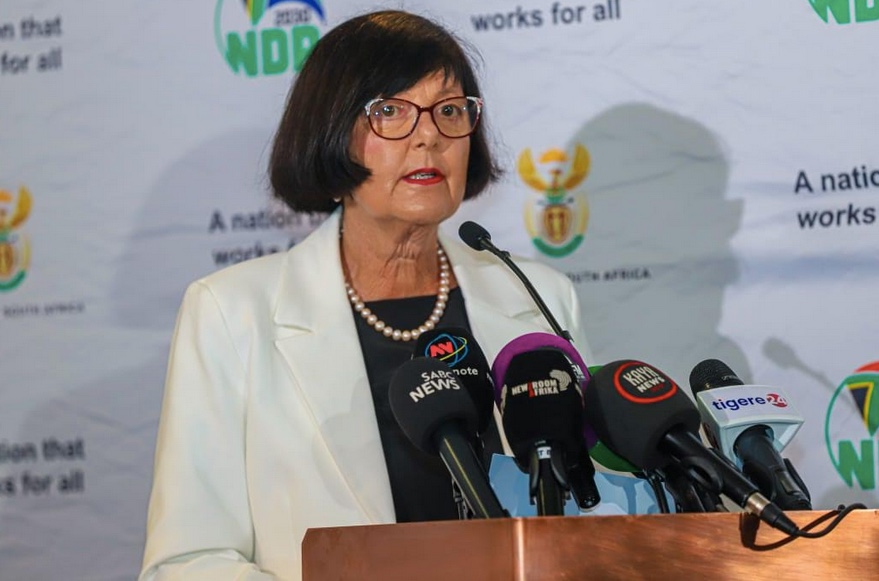
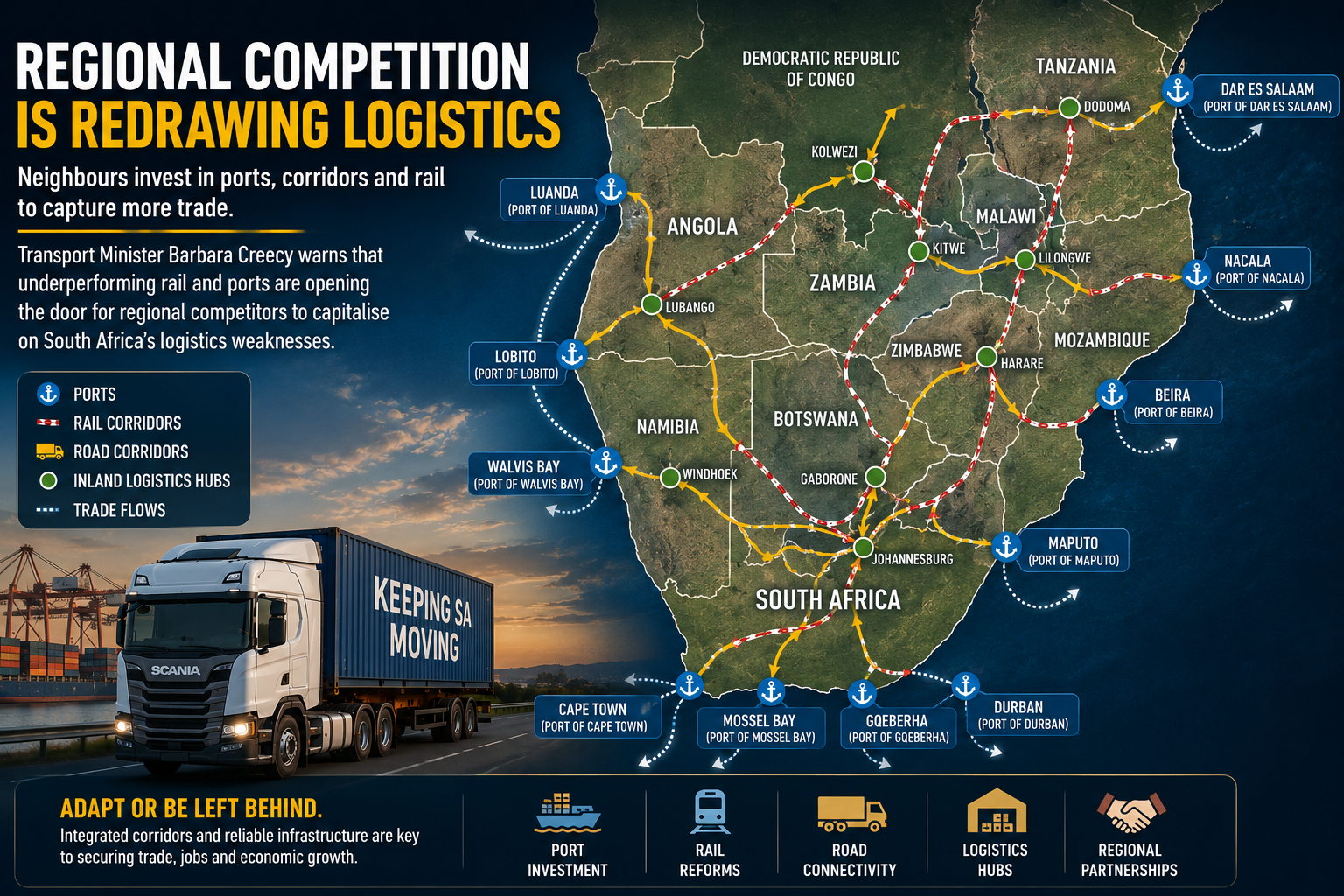
While South Africa’s rail and port recovery activates, the road freight industry continues to sustain the country’s logistics momentum. Trucks remain the backbone of national supply chains, keeping freight moving despite years of infrastructure underperformance. Speaking at the 2026 Southern African Transport Conference (SATC), Transport Minister Barbara Creecy warned that unless South Africa accelerates transport reform, neighbouring countries stand ready to capitalise on the country’s logistics weaknesses.
Adapt or be left behind as neighbours seize opportunities
South Africa’s logistics weaknesses have made the country vulnerable – and neighbours are ready to exploit the situation. That was the warning from Transport Minister Barbara Creecy during her opening address at the 2026 Southern African Transport Conference, held under the theme “Developing and Sustaining Transport Systems in an Uncertain World.”
She said transport failures have moved beyond operational inconvenience and now threaten trade, jobs and national competitiveness.
“These disruptions ripple through passenger journeys, freight movements and the efficiency of supply chains that support our economy. When transport faces disruption, market efficiencies are compromised and the sector’s capacity to add value to goods, to jobs and to social well-being is undermined,” she said.
Creecy’s strongest warning centred on South Africa’s declining logistics competitiveness. “In the South African context, years of under-investment in logistics infrastructure and the post-pandemic downturn in rail and port performance have led to increased competition from our neighbours, who threaten to capitalise on our logistics vulnerabilities,” she said.
Rail reform takes centre stage
Creecy said rail and port reform now sit “at the centre of government’s agenda for the transport sector”, with restoring rail freight forming a key objective.
“Our ambitious reforms in the rail space seek to re-establish rail as the backbone of the freight logistics system,” she said.
She argued that shifting freight from road to rail would improve safety, reduce congestion and cut emissions. “Increased utilisation of rail transport enhances road safety, decreases congestion on our roads, reduces wear and tear on road surfaces, and, critically, is responsible for lower CO2 emissions.”
A major milestone has been the opening of the national rail network to private operators, with 11 private Train Operating Companies approved earlier this year.
“These TOCs will bring their expertise and capital to rail operations, whilst the network will remain state-owned and belong to the people of South Africa,” Creecy said. Operations are expected to begin in April 2027.
“These operators will contribute significantly to government’s objective of moving 250 million tonnes of freight on the Transnet rail network by 2030,” she added.
Passenger rail recovery continues
Creecy said passenger rail is steadily recovering after the severe decline experienced during the Covid pandemic and following widespread infrastructure vandalism.
She said 35 of 40 priority rail corridors have now been restored.
“In the 2020/21 financial year, in the immediate aftermath of the Covid pandemic and widespread vandalism and destruction of rail infrastructure, the Passenger Rail Agency of South Africa (PRASA) recorded 10 million passenger trips. By the end of the 2025/26 financial year, 101 million passenger trips were recorded.” Government’s target is to restore passenger volumes to 600 million trips annually by 2030/31.
She also highlighted the introduction of the locally manufactured blue Isitimela Sabantu “People’s Train”. “The provision of passenger rail to working-class South Africans is a socioeconomic imperative.”
Technology, energy and digital transformation
Creecy said future transport planning must also embrace cleaner energy and digital technologies.
“Underpinning our current reform agenda is the notion that we cannot continue with a business-as-usual approach to the challenges we face. If we do not adapt to the current geopolitical realities with which we are confronted, we will be left behind.”
She cited developments including the Ngqura Liquid Gas Terminal, the Boegoebaai Port project, green hydrogen initiatives and sustainable aviation fuels as examples of transport’s growing role in South Africa’s energy transition.
Government is also working towards a fully digitised transport platform. “At a broader level, the Department and its 20 entities will work together to develop a single digitised transport sector platform that will host all online permitting services through a common citizen interface,” she said.
Reform must now become delivery
Creecy concluded by stressing that policy alone will not be enough, calling for sustained cooperation between government, industry and investors.
“I reiterate our collective vision: a transport system that is integrated, sustainable, resilient and inclusive; that strengthens our economy, safeguards our environment, and serves all South Africans with dignity and efficiency. The road ahead will demand steadfast leadership, prudent policy, and sustained investment. With your partnership, we can deliver a transport future that is robust against uncertainty and beneficial to every citizen.”
Editor’s Comment: For the road freight industry, the Minister’s message reinforces a reality operators have lived with for years. Trucks continue to carry the overwhelming share of South Africa’s freight while rail recovery gathers momentum. If the promised reforms materialise, logistics operators stand to benefit from a more balanced freight network. The challenge now shifts from announcing reforms to delivering them.
Click on photographs to enlarge