The global trucking industry is generally defined by incremental gains but Scania overseas is currently pushing into genuinely pioneering territory with a demonstration that blends advanced engineering with lateral systems thinking. The result is a glimpse of a transport future where heavy-duty trucks are not just energy consumers but actively supplying electricity to the grid. It is the kind of innovation that carries both social and environmental weight, redefining how fleets, infrastructure and energy systems may converge in the years ahead.
Heavy transport meets the energy system
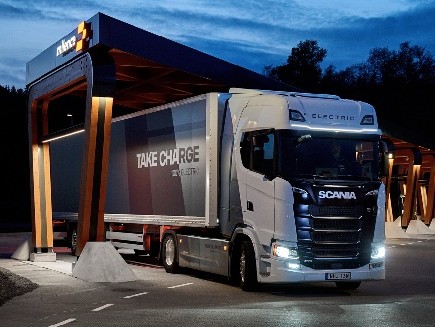
Scania has successfully demonstrated one of the world’s first vehicle-to-grid (V2G) implementations for heavy commercial vehicles using the Megawatt Charging System (MCS), marking a significant step towards integrating battery-electric freight into broader energy networks.
The demonstration shows that electric trucks can do more than move goods between depots and destinations. Through bi-directional charging, vehicles can also support the power grid by providing flexibility services including peak shaving, grid balancing and energy storage.
As electrification accelerates across heavy transport, electricity networks face new structural pressures. Large-scale depot charging introduces concentrated demand peaks that challenge local infrastructure. Yet the same vehicles that create this demand also represent a distributed, mobile energy reserve when parked.
Scania’s approach reframes this tension as an opportunity. By enabling energy to flow both into and out of truck batteries, fleet operations begin to sit directly within the logic of energy system optimisation rather than simply drawing from it.
Megawatt charging as the enabling layer
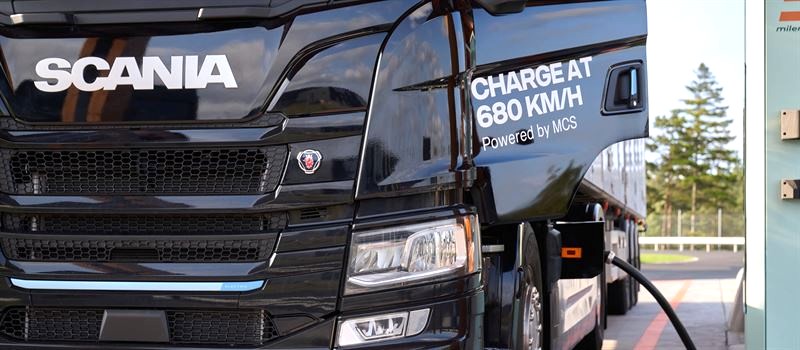
At the centre of the demonstration is the Megawatt Charging System, a next-generation standard designed for ultra-fast charging of heavy electric vehicles. Its role extends beyond speed. It provides the technical foundation for controlled, high-power energy exchange between vehicle and grid.
The system enables secure real-time communication between truck, charger and energy management platforms. This allows charging and discharging to be dynamically controlled according to transport schedules and grid conditions, rather than operating as a one-way process dictated solely by vehicle needs.
“What makes this significant is not only the bi-directional energy flow itself, but the ability to combine megawatt charging with intelligent energy management,” says Yorben Muller, Product Manager Charging, TRATON.
“To our knowledge, this is one of the world’s first demonstrations of vehicle-to-grid functionality using MCS for heavy commercial vehicles. The truck, charger and energy system can communicate with each other in real time, creating the foundation for heavy electric vehicles to become active and controllable assets in the energy system.”
The demonstration reached up to 1000 A and 750 kW, underscoring the scale at which heavy transport is now being integrated into advanced charging architectures.
Trucks as distributed energy assets
The implications extend well beyond depot efficiency. Bi-directional charging opens the door for trucks to operate as decentralised energy assets, particularly when parked for extended periods.
Depot environments become not only logistics hubs but also managed energy nodes capable of interacting with local generation and grid demand.
By enabling controlled energy flow, operators can better align charging with renewable availability, including on-site solar generation. This improves the utilisation of clean energy while reducing strain on constrained grid connections.
“Electric trucks will not only consume electricity, they can also become an active resource in the energy system,” says Tobias Ejderhamn, Global Manager, Transformation & New Business, Scania. “This shift transforms the fleet operator’s role from solely providing transport services to also offering energy flexibility.”
Ejderhamn adds that the combination of high-power charging and intelligent energy management may also strengthen the business case for battery-electric trucks by introducing new operational optimisation and cost-reduction pathways.
System value beyond transport
The demonstration highlights several functional capabilities that position vehicle-to-grid integration as a broader infrastructure innovation rather than a niche application:
- Bi-directional charging and discharging through MCS
- Real-time communication between vehicle, charger and energy systems
- Backend-controlled energy management
- Integration with external charging and energy platforms
- Controlled energy flow through the EV charging interface (EVSE)
Taken together, these functions point towards a future in which electric truck fleets are actively scheduled not only for logistics efficiency but also for energy market participation.
For charge point operators and energy providers, the model introduces additional value streams. Higher utilisation of charging assets and improved local grid efficiency could help justify infrastructure investment at scale, while supporting wider electrification goals.
Early-stage deployment with long-term implications
While the technology is still in its early stages, its most immediate application is expected in depot-based operations. These environments provide the dwell time necessary for controlled charging and discharging cycles, as well as predictable fleet scheduling that can align with grid demand patterns.
Over time, the concept could extend into broader flexibility markets, where aggregated vehicle fleets contribute to balancing services and system stability.
The significance of the Scania demonstration lies not only in technical achievement but in conceptual shift.
Heavy transport is no longer positioned solely as a grid challenge but increasingly as part of the solution.
Fact summary
- Vehicle-to-grid enables electricity to flow both to and from the vehicle battery.
- MCS is designed for megawatt-level charging of heavy commercial vehicles.
- The demonstration reached up to 1000 A / 750 kW.
- This is among the world’s first demonstrations of bi-directional power transfer using MCS in heavy-duty trucks.
- The system enables secure communication between vehicle and charging infrastructure.
- The setup supports both charging and discharging through a single interface.
- Designed to support future services including peak shaving and frequency balancing.
Editor’s Comment: What Scania is demonstrating here is more than a charging innovation – it is a structural rethinking of how heavy transport interacts with energy systems at large. The real breakthrough is not simply bi-directional power flow but the recognition that freight fleets can become stabilising assets within a volatile and increasingly renewable grid. If scaled effectively, this approach could blur the boundary between transport operator and energy participant. In that convergence lies both the commercial opportunity and the system resilience that future logistics networks will depend on.
Click on photographs to enlarge