South Africa continues to record one of the highest per-capita road fatality rates in the world, with thousands of lives lost every year on routes that carry the country’s freight, commuters and communities. Against this tragic backdrop, the need for joint public–private road safety initiatives has never been more urgent. A sustainable, community-rooted culture of road safety must be built to prevent loss of life.
Limpopo has stepped decisively into that challenge with its move to take full custodianship of the Limpopo Road Safety Programme (LRSP), marking the start of a new five-year strategy designed to cut provincial road deaths and serious injuries by half by 2030.
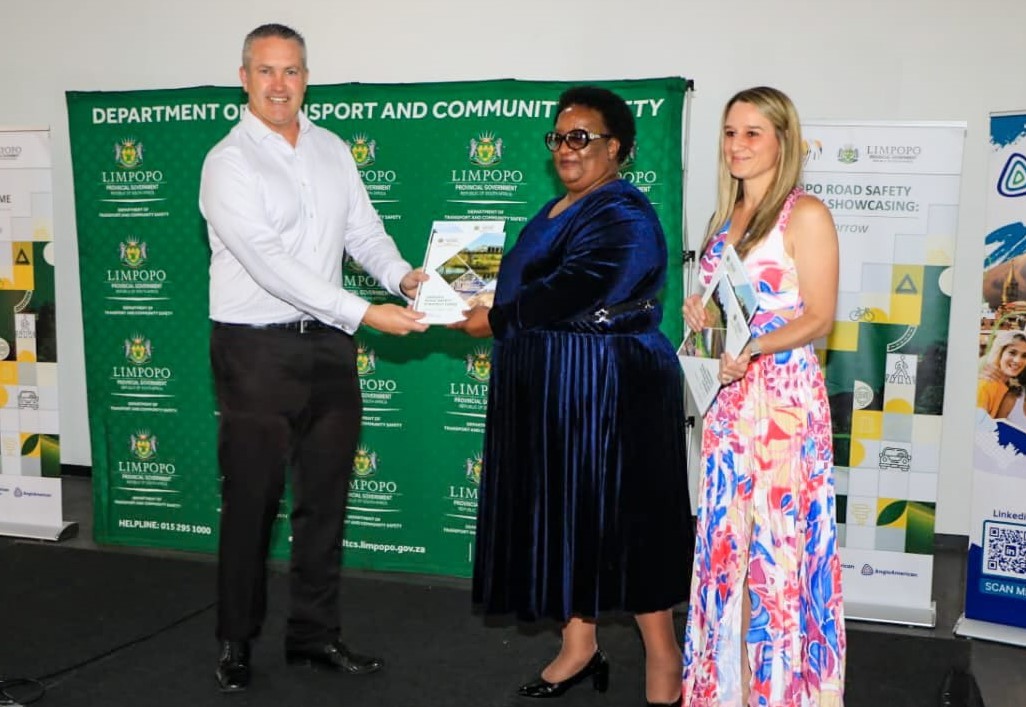
At the recent ‘Custodianship 2026’ event held in Polokwane, custodianship of the LRSP was officially handed to the Limpopo Department of Transport (DoT), which now takes over from the Anglo American Foundation and the Impact Catalyst who have over recent years demonstrated what coordinated, data-based road safety interventions in the province can deliver.
According to MEC Violet Mathye: “Our participation in this programme was guided by the noble endeavour of forming continuous partnerships that are at the centre of this Government’s developmental agenda.”
Evidence, engineering and enforcement
The LRSP is built on the Safe System Approach and grounded in measurable evidence. Its next phase aligns with the United Nations Decade of Action for Road Safety 2021–2030, targeting a 50 percent reduction in fatalities and serious injuries.
A major pillar of this is the iRAP (International Road Assessment Programme) evaluation of more than 1 500 kilometres of high-risk provincial roads. The findings were unambiguous: many routes fell below the 3-star safety threshold for vehicle occupants.
“This data allows us to target our interventions where they matter most,” says Dr Jonathan James, Programme Manager at the Impact Catalyst. “By integrating data from multiple departments, the province can act with greater transparency, accountability and precision.”
This evidence now shapes infrastructure upgrades, signage improvements and enforcement priorities along Limpopo’s highest-risk corridors.
Turning strategy into life-saving action
Years of structured planning have already produced significant gains:
- Over 1 100 Emergency Care Officers trained in updated emergency protocols.
- More than 3 000 learners reached through VIA school safety programmes.
- 112 young people assisted to obtain learner licences and 26 now licensed drivers.
- 89 officials trained in Safe System principles.
These interventions tighten capacity across emergency response, youth development, behaviour change and institutional decision-making.
Collaboration at scale
Delivered through collaboration with provincial departments, the CSIR, the University of Johannesburg and municipalities including Musina and Blouberg, the LRSP has shown that targeted engineering, data and community engagement can combine effectively at scale.
As Dr Mari Romijn, Head of Capable State at the Impact Catalyst notes: “We’re building the systems, skills and partnerships that make safer roads everyone’s responsibility. When communities, learners and officials work together, real change happens.”
Now, with custodianship formally transferred to the Department of Transport and Community Safety, the Province can embed and grow these gains. “This programme is more than a project – it’s a blueprint for lasting change,” says Dr James.
MEC Mathye concludes: “As we receive the Limpopo Road Safety Strategy and Action Plan, we are also committing that it will be fully implemented. This is the only way through which we can fully attain a road fatality-free society.”
Editor’s comment: South Africa’s stubbornly high annual road death figures remain one of the country’s most urgent public safety failures. Limpopo’s approach offers a reminder that lasting reductions require more than sporadic enforcement or seasonal campaigns. Measurable improvements only come from evidence-led engineering, institutional capability and community-level engagement working in tandem. If Limpopo sustains the discipline shown in its first phase and continues scaling its Safe System foundations, it could help demonstrate how all provinces can finally bring sustainable death-prevention strategies to our road network.
Click on photograph to enlarge